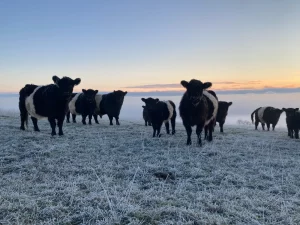
If you have stayed with us, you will have seen them. Black cattle with a broad white belt around the middle, grazing the pastures around the farm. They are Belted Galloways — “belties” for short, or “Oreo cows” as some of our guests affectionately call them — and they are as much a part of Mulino Lodge as the views and the quiet. This post is for anyone who has watched them from the balcony and wondered what they are, why we keep them, and how they fit into the working farm you are staying on.
An old breed, well suited to this hill
The Belted Galloway is a native British breed, originally from the Galloway region of south-west Scotland. They are hardy, slow-maturing cattle bred over centuries to thrive on rough upland grazing in weather that would trouble more delicate breeds. That double coat — a coarse outer layer over a soft, insulating underlayer — means they do not need housing through winter the way many cattle do. The distinctive white belt is simply how the breed has always looked; there is no practical reason for it, but it does make them very easy to count across a field at dusk.
Our herd is outwintered at 900ft and is purely grass fed, with no concentrates at any point in the year. They are rotationally grazed across a mixture of hill pasture and improved grassland, and we use no fertiliser or sprays on any of our pastures. It is a low-input, forage-based system — exactly the kind of farming the breed was made for, and the kind that keeps our pastures, hedgerows and wildlife in good heart. If you have read about our wider approach to farming with nature, the cattle are central to it. Grazing animals, managed well, build soil health rather than strip it.
The Madge Hill herd
We breed our belties under the Madge Hill prefix — named after the rise of ground they graze, the same Madge Hill many guests walk to for the sunset. The herd was established in 2018 and now runs to around twenty breeding cows. Our foundation bull was Shelsleys Stanley, and our female lines are built on Bigginvale, Barnwood and Crackley breeding — families chosen for their hardiness, their milkiness and their easy temperament.
They share the farm with our commercial sheep flock and our small stud of Shire horses.
From pasture to plate
Belted Galloway beef has a real reputation among people who know their meat. Because the cattle grow slowly on a grass diet, the beef is well-marbled, deeply flavoured and a world away from anything intensively reared. We do not sell it from the farm ourselves, apart from the occasional run of beef boxes — instead, our beltie beef is sold through Stanedge Grange Butchery, an award-winning farm shop and butchery at Newhaven near Buxton, about half an hour from us across the Peak District. If you want to take a taste of the Peaks home with you, or cook something special on the outdoor kitchen Blackstone during your stay, it is well worth the trip.
Watching them during your stay
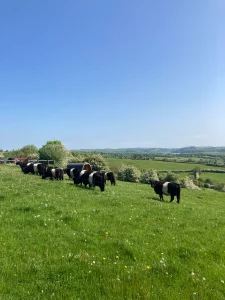
Depending on the grazing rotation, you usually do not have to go far to see the herd. When grazing pastures closest to the farm, the balcony at Ewe Lodge, or the decking at Bluebell , Damson and Lavender pods, provides the perfect viewpoint.
If you fancy stretching your legs, our guest walk down to the Red Lion at Kniveton passes through some beautiful countryside, with a CAMRA award-winning pub at the halfway point.
A request, if we may: please admire them from the field edge rather than entering the field and keep dogs on leads around livestock. They are friendly, but they are working cattle, not pets, and a quiet distance keeps everyone — cattle, dogs and people — relaxed.
If watching belties graze from your own private balcony sounds like the kind of break you need, you can check availability for our pods and the cabin at mulinolodge.co.uk/stay.